
Autodiscovery HEAD360 (Version 3)
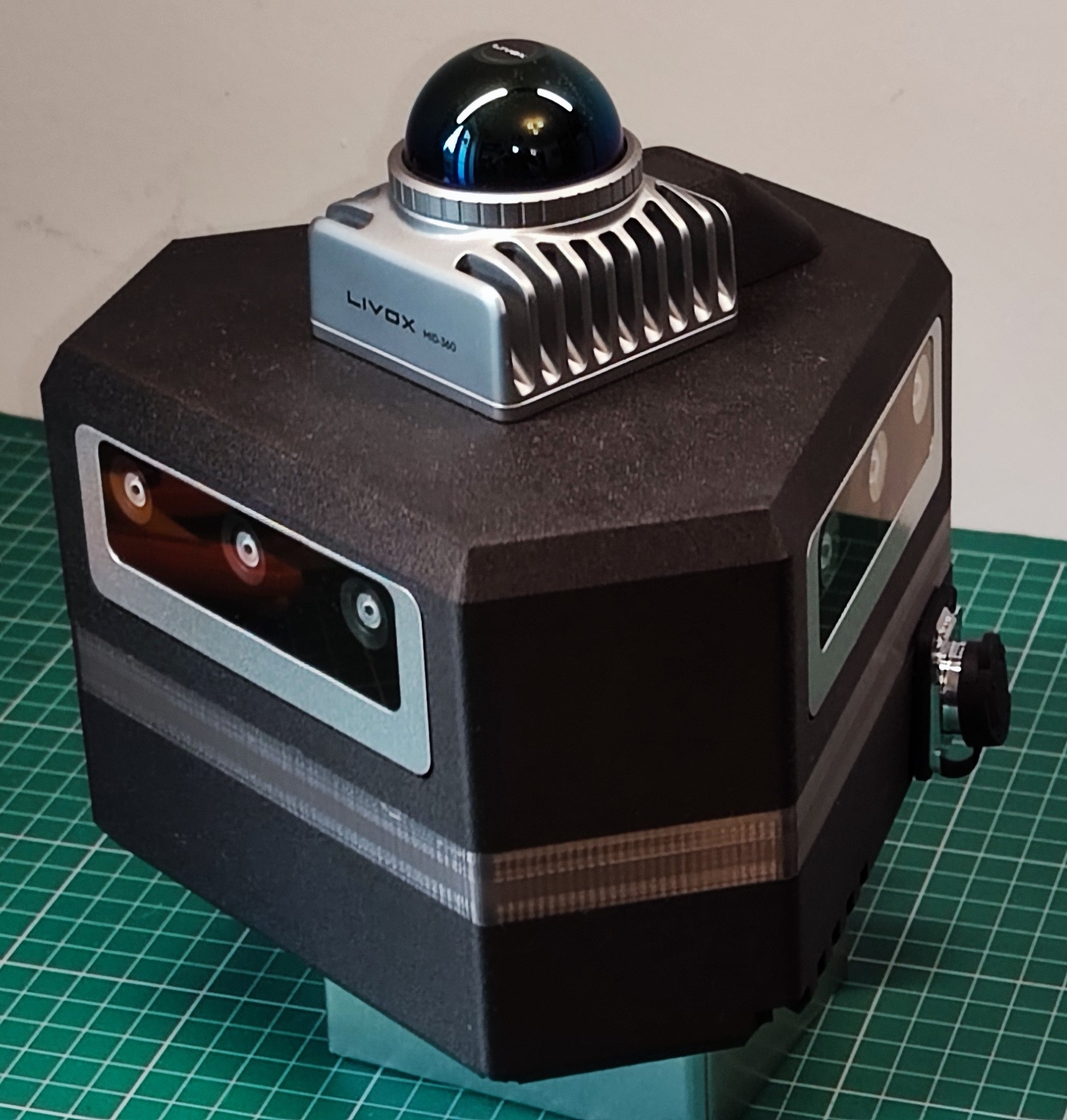
The HEAD360 Version 3 is a state-of-the-art, fully integrated situational awareness and autonomous navigation device designed for advanced mobile robots and humanoids. Offering 360-degree high-density point clouds and multi-camera edge computing, Version 3 brings significant upgrades in processing power, communication bandwidth, and detection accuracy.
Technical Specifications
Sensors & Vision
| Feature | Specification |
|---|---|
| Primary 3D Sensor | High-density omnidirectional 3D LIDAR with a 360° horizontal field of view. |
| Vision & Depth | Three (3) wide-FOV 4D depth cameras. |
| Night Operation | Built-in high-power LED flood lights for illumination in zero-lux environments. |
Computing & AI
| Feature | Specification |
|---|---|
| Edge AI Processors | Dedicated on-board Neural Processing Units integrated into each of the three 4D cameras for standalone app execution. |
| Main Compute Node (High-Performance Tier) | Advanced AI compute node with 128GB memory for intensive neural network workloads. |
| Main Compute Node (Power-Efficient Tier) | Energy-efficient x86 compute node with 32GB RAM for sustained deployment. |
Networking & Communications
| Feature | Specification |
|---|---|
| Router | Built-in advanced multi-gigabit Wi-Fi 7 network routing device. |
| Cellular | 5G communication support via optional USB expansion. |
| Audio | Integrated multi-microphone array and speakers for voice. |
Mechanical & Electrical
| Feature | Specification |
|---|---|
| Power Supply | Built-in power regulation supporting a wide input range of 24V – 90V DC. |
| Environmental | IP65 rated from above (fully IP65 rated when integrated and sealed correctly on the host robot). |
| Thermal | Integrated active and passive thermal management system. |
Software & Compatibility
| Feature | Specification |
|---|---|
| Software Stack | Custom open-source software built for ROS 2 Jazzy and Navigation 2 (Nav2). Accessible to customers via the Autodiscovery GitHub. |
| Middleware | Zenoh DDS for low-latency network communication. |
| Platform Compatibility | Out-of-the-box compatibility with a wide range of quadruped, wheeled, and tracked robotic platforms including Unitree A2 and A2-W, Unitree B2, AgileX robots (Scout Mini, Bunker Mini, Ranger, Bunker Pro), and many more. |
Core Capabilities Explained
3D Mapping and 3D Navigation
The HEAD360 leverages the fusion of its omnidirectional 3D LIDAR and the spatial depth data from its three 4D cameras to generate pristine, high-density point clouds. This allows the robot to perform highly accurate Simultaneous Localization and Mapping (SLAM). The integrated Navigation 2 (Nav2) stack uses these real-time 3D maps to execute agile obstacle avoidance, dynamic path re-planning, and safe traversal through complex topologies—ranging from dense industrial facilities to unstructured outdoor environments.
Distributed AI Processing (Edge & Core)
The payload utilizes a distributed compute architecture to maximize efficiency. Each of the three 4D cameras contains its own independent AI co-processor. This means lightweight machine learning models (like spatial feature tracking and raw object detection) run directly "on the edge" inside the cameras without taxing the main system. Meanwhile, the central compute node (equipped with up to 128GB of memory) acts as the brain for heavy-duty AI workloads, processing complex multi-layered neural networks concurrently.
Advanced Detection Capabilities
Because of its immense onboard compute power, the HEAD360 natively supports a wide array of advanced detection models, including:
- Human & Demographic Analysis: Can detect people, track multi-person movement, perform facial recognition, and extract demographic and sentiment data.
- Security & Logistics: Capable of running Automatic License Plate Recognition (ALPR) to identify and log vehicles in real-time.
- Custom Models: Users can deploy their own custom-trained neural networks for specific industrial inspections or anomaly detection.
Voice Control and Voice Interaction
The inclusion of an onboard microphone array and high-fidelity speakers transforms how operators interact with the robotic platform. The HEAD360 supports natural language processing (NLP), allowing it to interpret and act on verbal commands. It can also respond audibly, providing verbal status updates, warnings to bystanders, or operating dynamically as a two-way communication node for remote operators.
ROS 2 Ecosystem and Zenoh DDS Advantages
Built entirely around ROS 2 Jazzy, the HEAD360 offers developers immediate access to the world’s most expansive open-source robotics ecosystem. This ensures rapid integration with existing software stacks, simulators, and fleet management tools.
Crucially, the system utilizes Zenoh DDS as its underlying middleware protocol. Zenoh provides distinct advantages over traditional DDS by vastly reducing network overhead and minimizing latency. This makes the HEAD360 highly resilient when transmitting heavy data payloads (like video streams and 3D point clouds) over constrained, unstable, or long-range Wi-Fi and 5G networks, ensuring continuous control and telemetry where traditional protocols would drop packets.